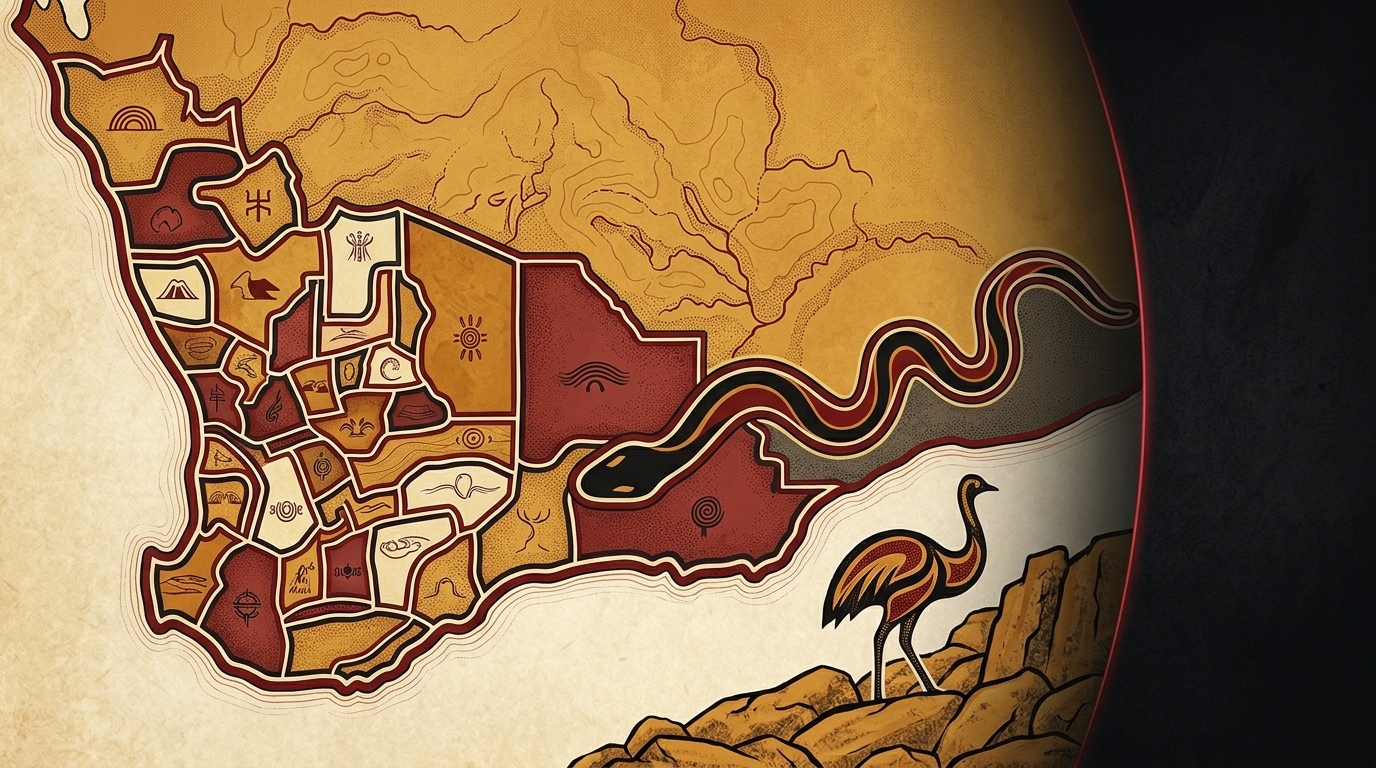
Why Bibbullmun, Not Noongar? The Ontological Framework
A rigorous ethnohistorical, linguistic, and geopolitical analysis of pre-contact sovereignty across South West Australia, challenging colonial administrative consolidations and asserting the unbroken 65,000+ year authority of the 23 Sovereign States of the Bibbullmun Confederation.
1. The Bibbullmun Argument: Unceded Pre-Contact Sovereignty
The term Bibbullmun (historically recorded across 19th-century orthographies as Bibulmun, Pibelmen, Bibilmum, and Bibbulman) represents the authentic, endonymic geopolitical designation for the ancient confederation of sovereign tribal states governing the entire South West region of Western Australia. Spanning over 65,000 years of continuous, unbroken human occupation, the Bibbullmun nation-state matrix operated under a highly sophisticated system of customary law (Katitjin Law), exogamous moiety governance (the four-skin matrilineal moieties of Bilyarup, Baluk, Kaat, and Yongka), and precise territorial boundaries defined by watershed catchments, monadnocks, and ecological frontiers.
In contrast, the term Noongar (or Nungar, Nyungar), which translates literally in the language as "man", "person", or "human being", was never utilized prior to British invasion as an overarching geopolitical or national identity. The flattening of 23 distinct, self-governing sovereign states into a homogenized administrative construct titled "the Noongar Nation" is a artifact of 20th-century colonial administration and state-sponsored native title consolidation. This administrative consolidation reached its zenith in the $1.3 billion South West Native Title Settlement, wherein the State of Western Australia required First Nations claimants to surrender all future native title and sovereign land claims in exchange for statutory trust land management.
Restoring the name Bibbullmun is not merely a semantic preference; it is a fundamental act of ontological self-determination and decolonial jurisprudence. Primary archival dispatches—ranging from Daisy Bates’ extensive field records (National Library of Australia, MS 365) to early colonial linguistic surveys by Foley (1865), Goldsworthy (1886), G. F. Moore (1842), and Rosendo Salvado (1851)—unanimously confirm that traditional owners identified themselves by their specific sovereign estate (such as Amangu, Yued, Whadjuk, Binjareb, Wardandi, Balardong, or Mineng) within the broader Bibbullmun civilizational sphere.
2. Linguistic Foundation: Dialectal Frontiers & AIATSIS Classifications
Linguistic analysis across the South West speech varieties provides incontrovertible proof of distinct territorial states. The AIATSIS AUSTLANG database catalogs individual language codes across the region: Pibelmen (W1), Mineng (W2), Wardandi (W3), Wudjari (W4), Goreng/Wirlomin (W5), Ganeang (W6), Wilman (W7), Waaluukin (W8), Whadjuk/Beeliar/Elaap (W9), Binjareb/Balardong (W10), Yued (W11), Amangu (W12), Nyakinyaki (W14), and Njunga (W15).
Each dialectal frontier corresponds precisely to ecological boundaries. For instance, the Amangu language of the Champion Bay, Irwin, and Greenough River catchments shares clear lexical roots with neighboring Mid-West and Yamatji speech communities while maintaining strict legal distinctions from the sub-coastal Yued language of the Moore River plains. As recorded in R. J. Foley’s 1865 Champion Bay vocabulary, specific terminology for land (*boodjar*), water (*bilya*), digging tools (*wanna*), and strangers (*mini*) demarked the northern legal boundary of the Bibbullmun non-circumcision law group against the circumcision law traditions of the interior desert.
By examining primary linguistic datasets rather than secondary colonial compilations, we observe that "Noongar" functioned solely as a generic noun in daily discourse (e.g., *Nidja noongar* – "This person"), whereas *Bibbullmun* denoted the overarching civilizational identity, lore, and territorial law uniting all 23 states.
3. Geopolitical Reality: The 23 Sovereign States & Watershed Governance
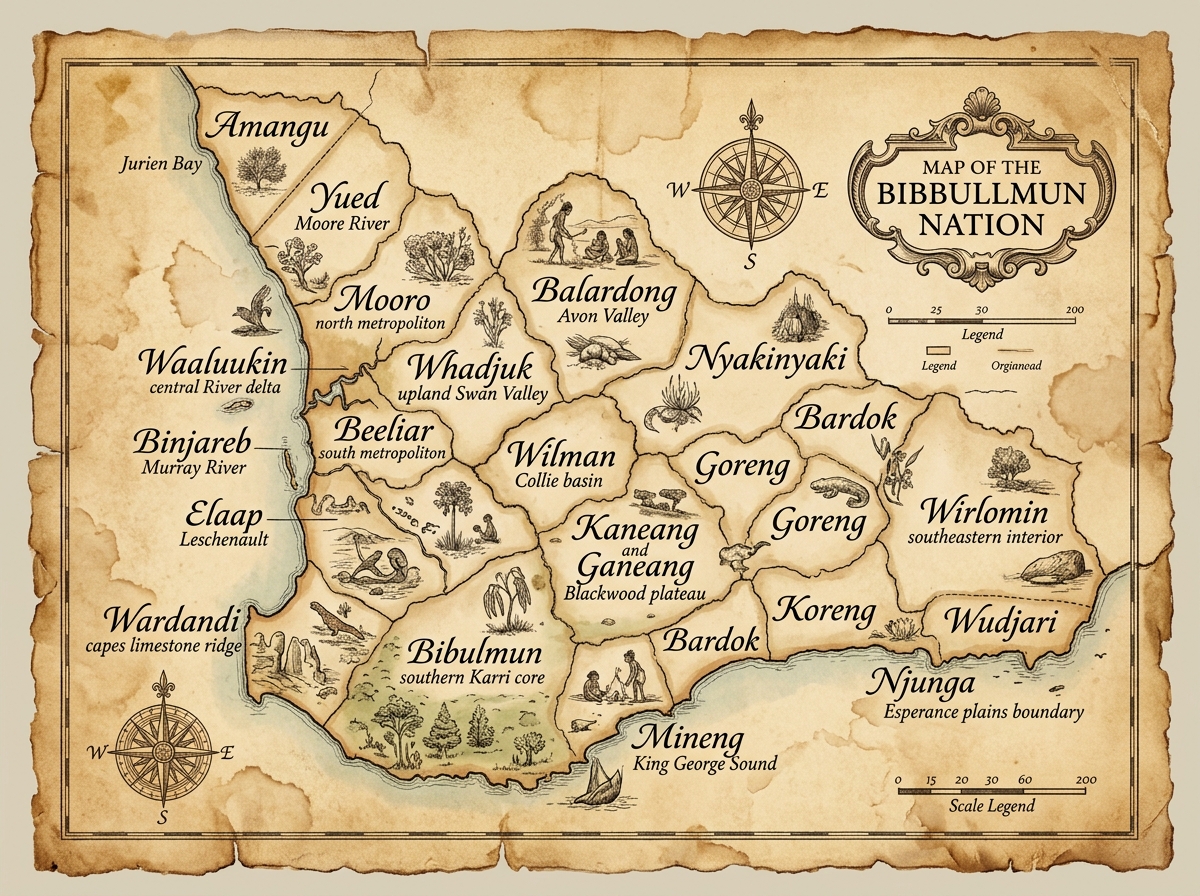
The 23 Sovereign States of Bibbullmun represent one of the most enduring geopolitical frameworks in human history. Far from being nomadic wanderers without fixed land tenure, Bibbullmun clans exercised exclusive possession and territorial jurisdiction over defined estates:
- Northern Frontier: Amangu (Geraldton, Irwin & Greenough Rivers) and Yued (Moore River & Victoria Plains).
- Metropolitan & Estuarine: Whadjuk (Derbarl Yerrigan / Swan River), Beeliar (Cockburn Sound), Elaap (Jandakot Wetlands), and Binjareb (Peel-Harvey Estuary & Murray River).
- South-West Coastal: Wardandi (Geographe Bay & Busselton), Bibulmun (Warren & Blackwood Rivers), and Mineng (King George Sound & Albany).
- Interior & Agricultural: Balardong (Avon Valley), Wilman (Collie River & Narrogin), Ganeang (Upper Blackwood), Goreng (Stirling Range), Wudjari (Fitzgerald River), Nyakinyaki (Merredin & Salt Lakes), Waaluukin (Wheatbelt), and Njunga (Esperance).
Governance across these 23 states was executed through formal inter-state assemblies (*Katitjin*), sacred fire management cycles (*Karl*), and estuarine fish weir operations. Under international law, as affirmed by the International Court of Justice in its seminal Western Sahara Advisory Opinion (1975), territories populated by organized tribes under recognized leaders and legal customs cannot be considered terra nullius. The Bibbullmun Confederation satisfies every criteria of statehood under customary international law (Montevideo Convention criteria: defined territory, permanent population, governance authority, and capacity for international relations).
4. Colonial Erasure & Administrative Consolidation
The statutory replacement of *Bibbullmun* sovereignty with colonial administration began with the enactment of the 1905 Aborigines Act (WA) and the establishment of segregated reserves such as Moore River Native Settlement and Carrolup. By forcibly removing children from their traditional estates across all 23 states and concentrating them into government institutions, the Chief Protector of Aborigines sought to erase state-specific lineages, clan affiliations, and customary land tenure.
In the modern era, state-centric native title legislation—specifically the Native Title Act 1993 (Cth) and the South West Native Title Settlement—further institutionalized this erasure. By requiring claimants to amalgamate into a single "Noongar Settlement Trust", the Australian legal framework forced the extinguishment of unceded sovereign title across 200,000 square kilometers in exchange for corporate trust shares. This site provides the intellectual, historical, and legal evidence to challenge this administrative extinguishment under Article 26 of the United Nations Declaration on the Rights of Indigenous Peoples (UNDRIP) and Article 52 of the Vienna Convention on the Law of Treaties.
5. Call to Action: Reclaiming Sovereign Futures
We invite scholars, legal practitioners, traditional owners, and global First Nations allies to explore the 700+ pages of scholarly research, 3,146 verified sources, and 28 normalized database tables compiled within the Bibbullmun Archive. Through rigorous documentation, primary archival evidence, and legal analysis, we assert that sovereignty was never ceded, never sold, and never surrendered.
Nidja Boodjar Bibbullmun – All Sovereignty Unceded.