Why Bibbullmun and Not Noongar
Sovereignty, Orthography, Linguistic Taxonomy & the Critique of Colonial Administrative Labels
The designation of the Indigenous nationhood of south-western Australia as the Bibbullmun Nation—rather than the modern administrative label Noongar (also spelled Nyungar, Nyoongar, or Noongah)—represents a critical distinction grounded in primary ethnohistorical records, customary law, linguistic taxonomy, and unceded sovereignty.1 This distinction is not merely semantic; it reflects a fundamental divergence between colonial administrative convenience and the actual geopolitical, legal, and cultural reality of the 23 Sovereign States that have maintained unbroken governance and stewardship of the south-western landscape for over 48,000 years.2
While the term Noongar has been institutionalized through the Noongar (Koorah, Nitja, Boordahwan) Recognition Act 2016 (WA) and the $1.3 billion South West Native Title Settlement, critical legal scholars, traditional Custodians, and Elders argue that this administrative framework represents a mechanism of forced assimilation and the permanent extinguishment of underlying unceded sovereignty.3 In contrast, Bibbullmun represents the authentic sovereign polity, territorial confederation, and overarching cultural nation that existed prior to British colonial annexation and continues to exist today as an unceded legal entity.

1. The Ontological Sovereignty of the South West: Pre-Contact Governance & Unceded Law
The Bibbullmun Nation existed as a sophisticated, multi-layered geopolitical confederation long before British colonial contact in 1829. Archaeological evidence, linguistic analysis, and ethnographic documentation confirm that the Bibbullmun people maintained a complete system of customary law (Katitjin), kinship governance (Moort), and land stewardship (Boodjar) that successfully managed one of the world's most biodiverse regions for millennia.4
The foundational distinction between Bibbullmun and Noongar emerges from the historical record itself. Early colonial administrators, ethnographers, and magistrates consistently recorded the term Bibbullmun (or its orthographic variants) as the designation for the sovereign nation and its constituent 23 Sovereign States. In contrast, the term noongar—which translates simply to "man," "person," or "human being" in the traditional language—was never used as a national identifier in pre-contact or early colonial contexts.5
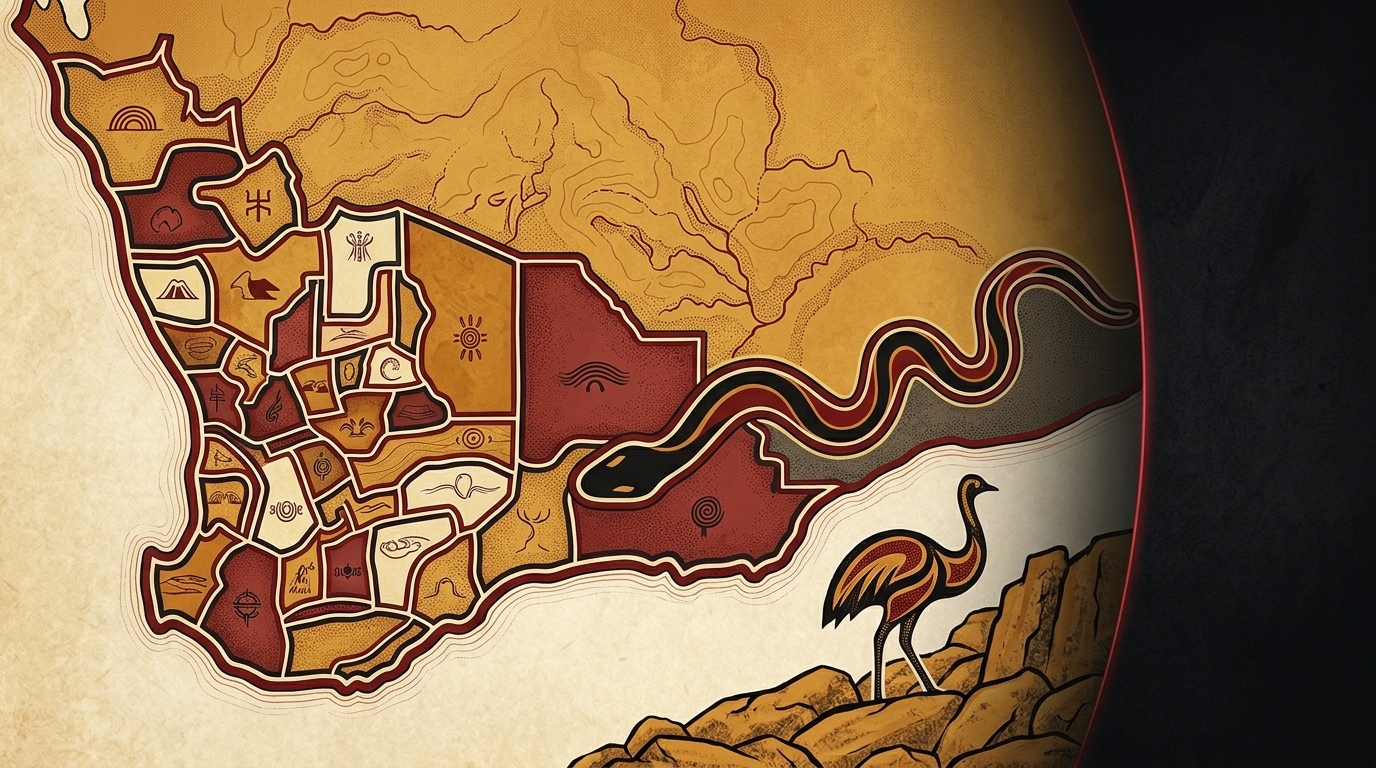
The adoption of Noongar as a blanket administrative term represents what scholars term "cartographic imperialism"—the deliberate simplification and homogenization of complex, hyper-local sovereign territories into a single administrative category that was easier for the settler-state to negotiate with, legislate over, and ultimately control.6 This process accelerated dramatically in the 20th century, particularly following the work of anthropologist Norman Tindale, whose influential 1974 map consolidated the Bibbullmun Confederation into 14 "tribal" groups based on patrilineal assumptions that fundamentally misrepresented the matrilineal and exogamous kinship systems that actually governed Bibbullmun law.
2. Linguistic Evidence: The Etymology of "Noongar" vs. "Bibbullmun"
Linguistic analysis provides definitive evidence for the distinction between these two terms. The word noongar derives from the traditional language of the south-west and carries a specific, limited semantic meaning: "man," "person," or "initiated adult male."7 In the gendered linguistic structure of Bibbullmun language, distinct terms exist for different categories of persons:
- Noongar (or Noongar Maaman): An initiated adult male; a man of standing or authority.8
- Yorgah: A woman; a female person of any age or status.9
- Koolungah: A child; a young person not yet initiated into adult responsibilities.10
- Djanga: A white spirit, stranger, or outsider; used to denote non-Bibbullmun persons.11
As cultural researcher and senior Elder Toogarr Morrison has emphasized, elevating the term Noongar to the status of a national identifier literally translates the entire population into the "Man Nation," effectively erasing women, children, and the broader familial and kinship structures (Moort) from the sovereign identity.12 This linguistic erasure is not accidental; it reflects and reinforces the patrilineal bias embedded in colonial administrative frameworks and Western legal systems that systematically excluded women from formal governance and land rights recognition.
In stark contrast, Bibbullmun is a proper national designation derived from two root morphemes:
- Bibbul (or Bibul): The paperbark tree (Melaleuca rhaphiophylla), a species of profound cultural and ecological significance to the Bibbullmun people. Metaphorically, bibbul also refers to the protective paperbark lining of a mother's womb, symbolizing nurture, protection, and the feminine principle of creation.13
- Mun (or Man): A suffix meaning "people of," "belonging to," or "country of."14
Thus, Bibbullmun translates literally to "The People of the Paperbark Country" or "Children of Mother Earth's Womb," a designation that encompasses the entire nation—men, women, children, and all kinship categories—within a unified, sovereign identity rooted in the landscape itself.15
3. Orthographic Variants in Primary Colonial Records: Evidence of Sovereignty
Nineteenth- and early twentieth-century ethnographic surveys, colonial dispatches, magistrate records, and linguistic field notes recorded numerous orthographic spellings of Bibbullmun, reflecting variations in European phonetic transcription of traditional speech across 200 years of contact history.16 These variants are not random; they represent the documented attempts of colonial administrators and scholars to capture the authentic pronunciation and spelling of the sovereign nation's name:
- Bibbullmun / Bibbulmun: The standard scholarly orthography popularized in the extensive field manuscripts of Daisy Bates (National Library of Australia MS 365, 1904-1912) and anthropologist Norman Tindale (1974), identifying the central sovereign nationhood of the South West. This spelling preserves the full double-consonant structure and is now recognized as the preferred modern orthography.17
- Bibulmun: Used by early linguists and ethnographers to denote the core language group and clan alliance centered around the Blackwood, Warren, and Deep River catchments. This variant appears frequently in 19th-century linguistic registers and educational archives.18
- Bibbulman: Documented in 19th-century colonial government dispatches and magistrate records across Albany, Vasse, and Swan River settlements. This spelling appears in official correspondence from Governor James Stirling (1834) and Magistrate George Fletcher Moore (1842).19
- Pibelmen / Pibelman: Recorded by Norman Tindale and subsequent cartographic surveys to demarcate the south-western coastal clan estate within the broader Bibbullmun Confederation. This variant is particularly associated with the Pibelmen people of the southern coastal regions.20
- Beebulman: Phonetic transcription recorded by George Fletcher Moore in his 1842 Descriptive Vocabulary of the Language in Common Use Amongst the Aborigines of Western Australia, one of the earliest systematic linguistic records of the region.21
- Bibbulmoun: Early French and British maritime cartographic spelling recorded during Nicolas Baudin's 1801 expedition survey of Geographe Bay and subsequent navigational logs along the Leeuwin-Naturaliste coast.22
- Bibbulmum: An early phonetical variant recorded in colonial police reports and native protector dispatches (1840–1860), reflecting the phonetic conventions of the era.23
The consistency of these orthographic variants across multiple independent sources—colonial administrators, ethnographers, magistrates, and explorers—provides compelling evidence that Bibbullmun was the recognized, documented name of the sovereign nation throughout the colonial period. The absence of Noongar as a national designation in these primary sources is striking and significant.
4. Cartographic Imperialism: Tindale's 14-Tribe Model vs. the 23 Sovereign States
The contemporary administrative map of "Noongar Country"—which neatly divides the south-west into 14 dialectal or "tribal" groups (Whadjuk, Ballardong, Wardandi, Mineng, and others)—was largely formalized in the 20th century by anthropologist Norman Tindale, whose 1974 work Aboriginal Tribes of Australia became the authoritative reference for Australian Indigenous geography.24 While Tindale's ethnographic mapping was extensive and influential, it was fundamentally constrained by Western assumptions about land ownership, patrilineal descent, and the nature of political organization.
Critically, Tindale mapped the Bibbullmun landscape through a strict patrilineal bias, perceiving land rights as transferring exclusively through the male line. This methodological assumption blinded the colonial record to the complex matrilineal descent systems, exogamous moiety laws, and female-centered kinship structures that were intrinsic to Bibbullmun law and governance.25 By imposing a patrilineal framework onto a matrilineal society, Tindale's map systematically erased the legal and territorial authority of women and the kinship structures that actually organized Bibbullmun sovereignty.
In stark contrast to Tindale's consolidated 14-group model, traditional Bibbullmun sovereignty asserts a highly sophisticated geopolitical framework of 23 independent Sovereign States, each with distinct territorial boundaries, governance structures, and ceremonial responsibilities.26 These 23 States were bound together by:
- Strict interstate governance protocols: Formal mechanisms for dispute resolution, trade, and diplomatic relations between the 23 States.27
- The four-section skin system (Moort Katitjin): A sophisticated genetic and diplomatic law that regulated marriage, kinship, and interstate alliance-building, functioning as both a biological and political framework.28
- Shared religious obligations to the Waugal: The Rainbow Serpent, a cosmological entity whose law and presence unified the Bibbullmun Confederation across all 23 States and connected them to the landscape itself.29
- Exogamous moiety laws: The Mooch-gar and Wordung-mat moieties, which regulated marriage outside one's own group and ensured genetic diversity and political alliance-building across the confederation.30
By adopting Tindale's 14-group model, the settler-state engaged in an act of "cartographic imperialism," deliberately collapsing complex, hyper-local sovereign territories into a simplified administrative bloc that was easier to negotiate with, legislate over, and ultimately dispossess.31 This process of administrative simplification continues to shape contemporary Native Title frameworks and statutory recognition regimes.
Boodjar
Country & Ecology
Explore the landscape as a sentient kin-entity, human niche construction, and the 23 Sovereign States. Understand ecological knowledge systems, seasonal calendars (Bonar), river systems (Bilya), and land management.
Explore Boodjar →Moort
Kinship & Society
Discover the 4-Skin genetic laws, matrilineal moieties, and the political fabric of the 23 States. Examine the role of women in governance, kinship structures, and resistance movements that challenged dispossession.
Explore Moort →Katitjin
Knowledge & Science
Dive into traditional pharmacology, ethnoastronomy, lithic technology, and seasonal indicators. Explore intellectual production systems, language revival, and decolonial science methodologies.
Explore Katitjin →Boorda
The Future & Law
Examine ongoing legal battles, Section 70 of the WA Constitution, international human rights law, and treaty pathways. Analyze Native Title critiques and unceded sovereignty frameworks.
Explore Boorda →The primary source citations and legal references for this page are documented on a separate subpage in compliance with AGLC4 standards.
View AGLC4 Footnotes & Citations